Tuesday, 4 February 2014

Then and Now #4 - Life of Early Humans

hunting
starting fire
On Monday, the Water group spent group time being early humans. The group had such great imagination and creativity that it seemed like we travelled back 160,000 years. We began group time by journeying into the forest and looked for shelter, hunted for food, built fire, and made beddings out of materials from the forest. They loved being hunters but I think one early vegan did exist in the group. Lucas insisted on reviving a hen that another child hunted and he cared for it until the end of our dramatization. The group also showed great teamwork when they gathered wood for the fire. The children noticed that it takes hard work to live the life of the early humans. They have to do and make everything from scratch.
gathering wood

Showing care
our bed
In the end I asked the children if they would like to live in the times of the early humans. Molly, Theo and Lucas would not want to because there are too many things to do and Lucas does not want to hunt animals. And Allye and Alfie quite enjoyed the life of early humans and wouldn't mind living around that time.

Then and Now #3 - The Housing Model


The children are really enjoying watching their 3D housing timeline grow. It starts off with caves and bone houses for the early humans continuing to mud houses for early farmers then log houses, castles, houses in the 50s and finally the modern city with high rises. The structures may seem very different in each time period but one thing the children agree on is that people always need shelter! However as they come to this conclusion, Alfie made a comment that made us ponder..."Well, there are people that have no homes and sleep on the street."

Thursday, 23 January 2014

Then and Now #2: Housing Evolution

Making the cave
Since the children were intrigued with the houses from the past, I decided to explore more into the evolution of houses from the past to present. The children understand that early people used caves as shelter and as time passed, humans learned to build their own instead of searching for caves. However the time concept is still hard for the children to grasp so I showed pictures of early man's life (especially how they looked). Immediately they noticed that early people looked very different from people nowadays. Here are some of their comments:

Making a bone house
Molly: They look like gorillas.
Alfie: They're not wearing clothes!
Theo: They hunt.
Allye: The elephants have fur! (And this started a whole other conversation about woolly mammoth!)
Brendan: There are bone houses!
Angela: Bone houses? We don't live in bone houses.

Painting the display
Making the loghouse
Placing the caves
Currently the children are working on a 3D timeline of the housing evolution. The Water group is very eager to display their model so children from other groups can see how houses have changed from the past to present.

Tuesday, 14 January 2014

Then and Now #1: Start of the New Unit

Drawing something from the past or the present

Last week, I asked the children to share their ideas of what existed a long time ago. As each child shared his/her idea, another would say: "But we have that now too!" They all looked quite confused.
Then we browsed through the book How People Lived by Jim Pipe, to help them compare the past with the present. The book showed how cavemen used to live and how other ancient civilizations were like. The children noticed many things from the past, like how there were no roads, people do laundry in a tub, and there was no bathroom! The children were especially interested in the different houses that people used to live in, starting from the caves for the cavemen to the modern skyscrapers that we have now.
Children's ideas before looking at How People Lived
Children's ideas after looking at the book

Thursday, 5 December 2013

We Decorate Our World #8 - Coast Salish Masks

Coast Salish Frog Spirit Mask
Coast Salish Shark Mask


On Tuesday, the Water Group and Wind Group partnered together to learn about a Coast Salish community that lives very close to us, the Musqueam. We learned that the Coast Salish and other First Nations use masks to tell stories during potlatches and the winter ceremonial dances. The masks may depict animals, humans or mythical beings and they are usually carved from a light wood so they are not too heavy to dance in.
preparing the paper for paper mache
First Nation connection


For the activity, the two groups made masks of their own using paper mache. As we waited for the paper mache to dry, the children looked through different Northwest Coast First Nation designs to put on their mask.

We Decorate Our World #7 - Face and Body Decorations


This week the Water group began exploring face and body decorations used by cultures around the world. On Monday, I showed the children pictures of people from various cultures with face or body decorations. As the children looked at the pictures, I noticed that the they would giggle and laugh because the people in the pictures looked funny to them. So I explained to the children that the designs on the people from each picture have special meanings and we should show our respect by being caring with our words and actions. After reflection, we were able to express our opinions in a way to show how we have become more knowledgeable of others by showing respect and appreciation with our words. After looking through the pictures, the children eagerly awaited to paint their faces.

Thursday, 28 November 2013

We Decorate our World #6 - Food as Decorations?


From our provocation activity, Brendan saw food being used as decorations. He was quite puzzled and asked why. I asked the rest of the group if they agree that food can be used as decorations or be decorated. They all shook their little heads and said no. Then I showed the children two pictures, a plain cookie and butterfly cookies. Then I asked them which one they preferred. They all picked the butterfly cookies. "Why?" I asked.

Theo said: "The butterfly cookies look better."
Alfie said: "The other cookie is plain, there's nothing on it!"
Allye said: "Because it's decorated."
Molly said: "I will feel very happy eating those butterfly cookies!"
Then I asked: "Why do you think the person made butterfly cookies and decorated them?"
Angela thought for a while and said: "Maybe the person that made it likes a butterfly."
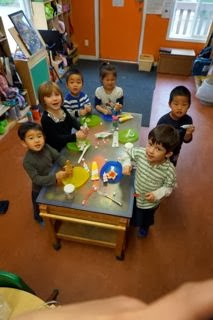
For our activity, the children made plain sugar cookies and chose how and what they want to use to decorate their cookies. They all loved it and of course generous in nature, they made enough to share with the whole group.